Industrial Automation Solutions for Palletizing, Machine Tending, and Pick & Place

Industrial automation is transforming how factories produce, with robots taking on a central role. As efficiency, flexibility, and sustainability grow more important, industrial automation solutions pair modular robots with intelligent AI. The result points toward the Smart Factory, where production stays fast, precise, and adaptable.

Key Takeaways

  • Industrial automation solutions replace manual, repetitive handling with robots. They target the tasks that limit output: palletizing, machine tending, and pick & place.
  • RobCo delivers hardware, software, and integration from one source. One partner, one predictable monthly rate, no upfront investment.
  • Physical AI lets the robots adapt to changing products without reprogramming, so mixed batches no longer stop the line.
  • Documented palletizing results: up to 80% less manual time, up to 5x more capacity, and ROI from day one.
  • Commissioning takes days, not months. We build and validate the cell as a digital twin before a single screw is turned.

The Bottleneck That Still Caps Production

Manufacturing faces the same pressures everywhere: a shrinking workforce, rising costs, and products that change faster than rigid lines can follow. Industrial automation answers these pressures, and it no longer requires a large capital project to start.

Skilled workers for repetitive tasks are hard to find and harder to keep. Every unfilled shift limits what the line can produce.

  • Labor shortage: Staff for loading, palletizing, and picking are scarce, and the manual station sets the daily ceiling on throughput.
  • Cost pressure: Overtime during peaks and inconsistent manual work raise the cost per part.
  • Rigid setups: Conveyors and fixed robotic cells handle one product well, but every changeover means downtime or reprogramming.
  • The Industry 4.0 barrier: Many plants still run at a low level of automation because new technology feels risky, complex and costly.

Industrial Automation Solutions Explained

Industrial automation solutions are systems that take over physical production tasks with robots, software, and sensors. In practice, they automate the work a person still does by hand: loading and unloading machines, palletizing, material handling, and pick & place. Unlike a single robot arm, a complete solution combines the hardware, the control software, and the integration into your existing line. The goal is simple: steady output, consistent quality, and fewer tasks that depend on filling a hard-to-hire shift.

Industrial robots sit at the center of this. They work with precision, run around the clock, and take on the repetitive or hazardous jobs people would rather avoid. What has changed is how quickly they adapt. Modular robots, guided by intelligent software, move from one task to the next without a new engineering project each time.

The Limits of Rigid Robots and Conveyor Systems

Traditional automation assumes uniformity. A conveyor system or a fixed robot cell is programmed for one part, one carton, one repeatable motion. Change the product, and the line needs reprogramming or requalification. That is why earlier automation technology struggled with mixed batches and frequent changeovers. Many plants concluded that variable production simply cannot be automated. That conclusion was right for that technology, but not for adaptive industrial automation systems.

Close-up of a modern, dark robotic arm for intelligent automation; the sleek design emphasizes the advanced technology in robotics and production.
A powerful robotic arm demonstrates its high load capacity for automating production by effortlessly lifting a 40 kg weight - an example of robust automation solutions.

Adaptive Automation With RobCo, Backed by Results

RobCo automates the tasks where rigid robotics and conveyors fail. Our systems use Physical AI to recognize new parts and adapt in real time, so a changed component does not trigger a reprogramming project. Instead of buying a fixed line, you deploy modular robots that load machines, palletize, pack, and handle material, and that keep learning during operation. A robot that adapts to your products beats one that forces your products to adapt to it.

The results carry across industries. RobCo’s palletizing deployments show it: up to 80% less manual time, up to 5x capacity, and ROI from day one. Precise placement also reduces damaged parts, cutting waste and rework. The XL module extends the same approach to heavy work, handling loads up to 40 kg for palletizing and heavy pick-and-place operations.

Success Story with Bempflinger: Mobile Palletizing

Here's what that looks like in practice: watch a manufacturer automate a manual palletizing station with RobCo.

Where Industrial Automation Delivers the Most

Automation pays off wherever a manual station limits throughput. Five applications stand out across manufacturing, food and beverage, automotive, and aerospace suppliers.

Task
What the robot does
Where it helps most
Loads and unloads CNC machines, presses, and injection molders continuously
Metalworking and precision parts with steady cycle demand
Stacks and destacks mixed and single-SKU pallets automatically
End-of-line packing with high pallet variety
Handles uneven parts and changing formats a fixed cell cannot
Assembly and sorting with volatile product mixes
Moves and transfers goods between stations inside the plant
Feeding and staging across the shop floor
Automates repetitive surface and quality steps with consistent force
Welding, gluing, and inspection lines

Across all five, the pattern is the same: the robot takes the repetitive station, and the line stops depending on a shift you can no longer reliably staff. This is where automation in manufacturing turns a labor problem into steady capacity, on the production floor and across logistics operations.

From Idea to Running Cell in Days, Not Months

Automating production once meant a long project that tied up resources and carried real risk. We have removed that. The path runs in three steps, and most of it happens before hardware arrives.

1. Potential analysis and concept: Together we find the stations with the highest automation potential. Instead of concept papers, our software builds a digital twin of your future cell right away.

2. Simulation and validation: You see the result before a screw is turned. We validate cycle times and motion in the simulation, so quality is built in from the start.

3. Fast implementation and start-up: The modular plug-and-produce hardware installs quickly. The programs from the digital twin transfer to the robot, and commissioning takes days instead of months.

This is how we answer the fear that automation takes too long. Plug-and-produce is a measurable promise, not a slogan.

Safe Operation Next to Your Team

Robots and people can share the same floor safely, as long as the system matches the right safety standard to its platform. Stationary cells and mobile platforms follow different frameworks. We scope the applicable safety standards for your layout and station, so safety is designed in, not bolted on. Addressing this concretely is part of delivering a complete solution, not an afterthought.

Configuring the Robot Without an Engineer

RobFlow is a visual, no-code interface that lets your production team reconfigure the robot without external specialists. A shift supervisor learns the RobCo software stack in days, not weeks. This is how you redeploy the robot to a new task using your existing staff—no engineering project, no external consultant, no hidden cost.

Industrial Automation Costs: Zero CapEx Upfront, ROI From Day One

Automation is assumed to mean a six- or seven-figure capital request before line one runs. Our robotics-as-a-service model removes that barrier.

Zero upfront investment: You rent the robots you need at a predictable monthly rate, with ROI from day one.
One partner, end to end: Hardware, software, deployment, and service come from RobCo, not from several vendors you have to coordinate.
Scalable capacity: Add or redeploy modules as production changes, without owning idle hardware.

Where a conventional line can demand €500,000 or more before it produces a single part, the rental model lets you prove value first and scale from there. This is how we answer the objection that industrial process automation is too expensive.

Industrial Automation in the Smart Factory

Factory automation reaches its full potential when machines, robots, and software share data in real time. This is the idea behind the smart factory, a core piece of Industry 4.0. Sensors feed live data and analytics into the system, so you can optimize each cycle as it runs. AI-supported vision adapts to unstructured environments, and each cell connects to the machines, control systems, and operator HMIs around it. Technologies of the Internet of Things (IoT) and cloud computing tie the plant together, turning isolated stations into a connected, self-optimizing operation.

Your Benefits of Industrial Automation at a Glance

Higher productivity

More parts and pallets per shift, without adding staff. Repetitive work moves to robots, so your team can do the extraordinary.

Lower cost

Zero upfront investment and a predictable monthly rate replace a capital project.

Flexible capacity

Scale robots up for peaks and redeploy them as production changes.

Consistent quality

Standardized, precise motion reduces errors and rework.

Safer work

Repetitive lifting and hazardous steps move to robots, under recognized safety standards.

Future-proof

Physical AI adapts to new parts and formats without reprogramming.

RobCo as Your Industrial Automation Partner

RobCo builds the next generation of Autonomous Industrial Robotics to help companies automate the ordinary, so humans can do the extraordinary. We deliver a complete solution from one source: modular hardware, a flexible portfolio of automation products including autonomous robots, intuitive software, and an integration team that ties them into your line. Our integrated hardware and software platform is designed to just work: easy to deploy, flexible to adapt, and continuously improving through AI. Offered through a robotics-as-a-service model with zero upfront investment, RobCo enables companies to adopt advanced automation without complexity or risk. And because we own and maintain the equipment, energy-efficient systems, predictive maintenance, and remote troubleshooting keep the cell running with minimal downtime. You get the benefits of robotics without needing a team of in-house specialists.

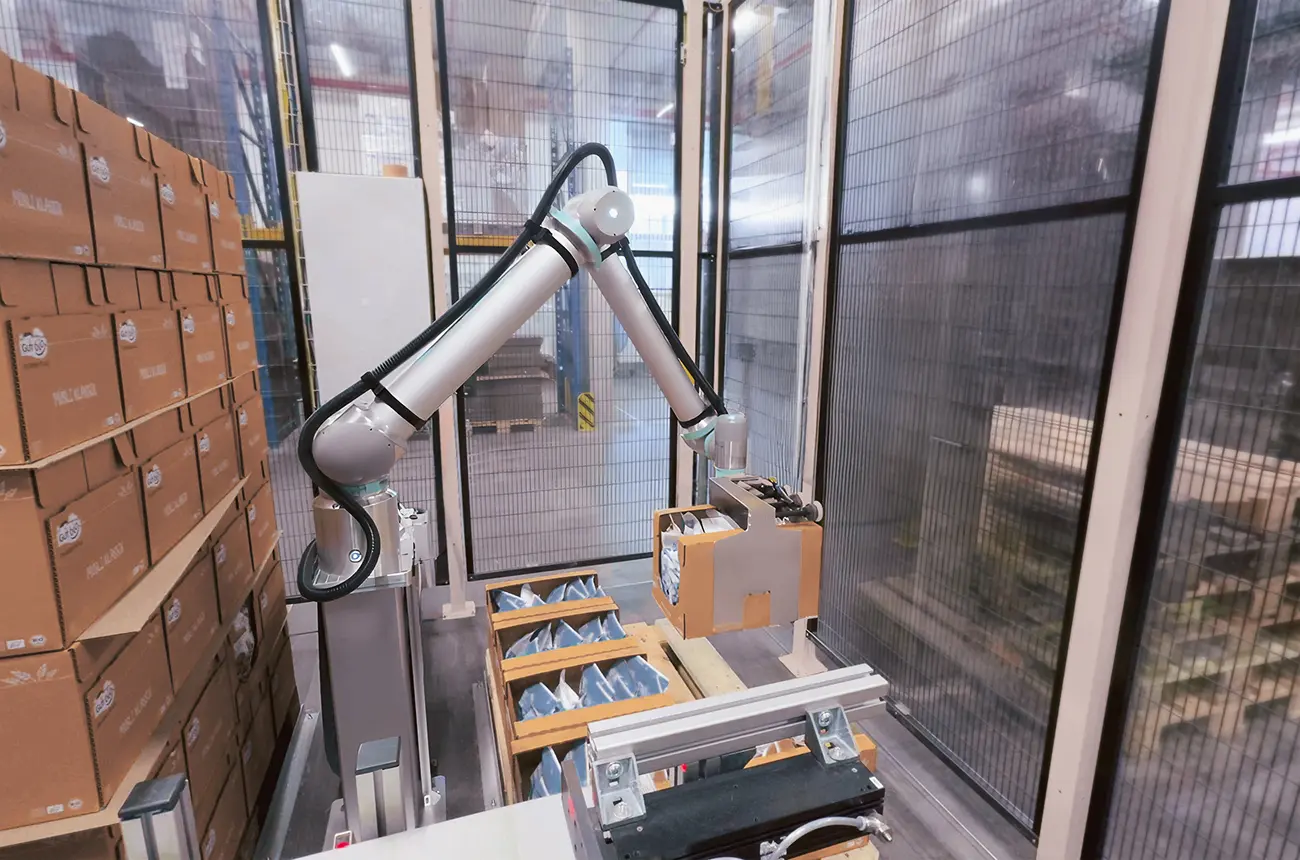
A robot arm works in a production cell and picks up a box from a pallet, a typical application for production automation and the optimization of logistics processes.
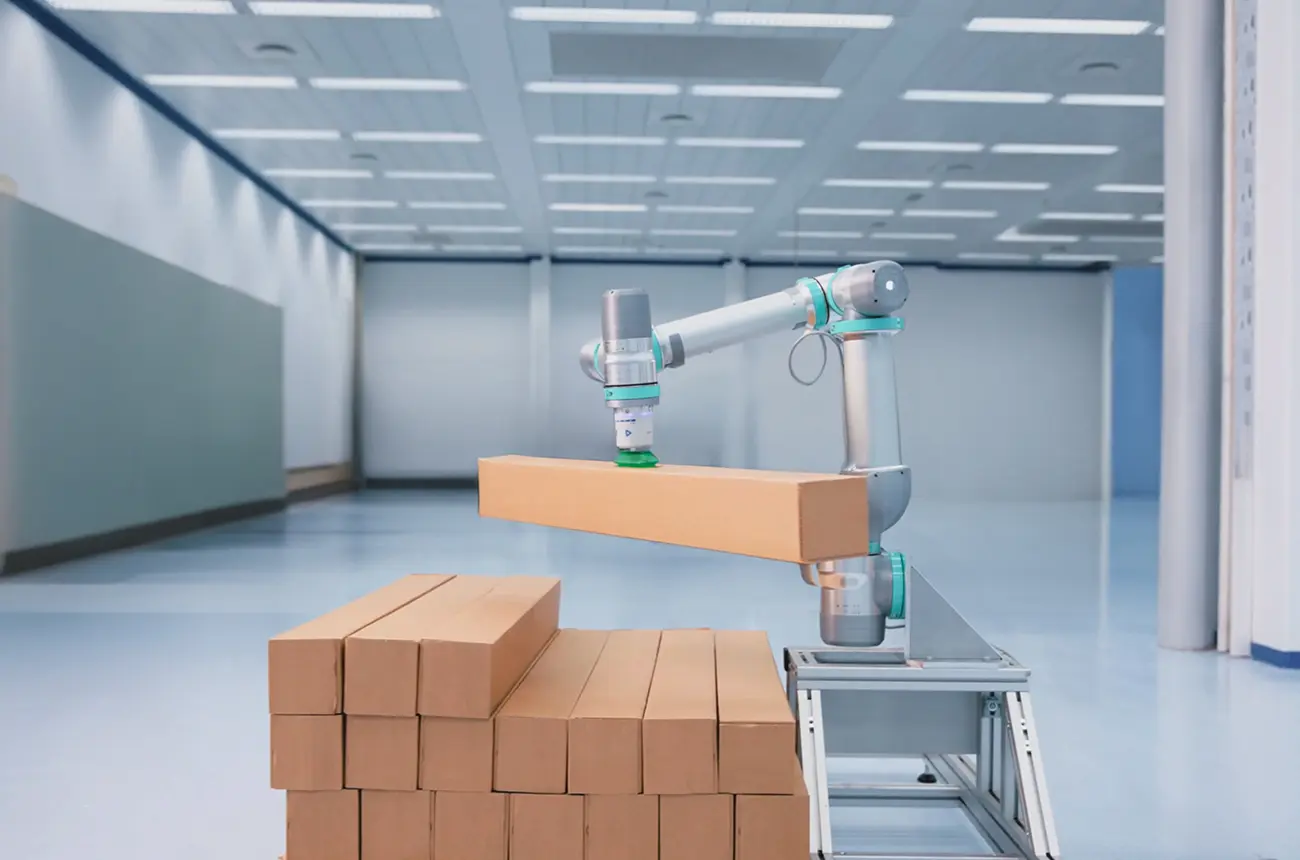
cRobot in automated production in a clean environment, precisely stacking long cartons. This application shows flexible automation in the industry for packaging and palletizing tasks.

Book a Consultation

With modular robots, manufacturers streamline production, improve efficiency, and stay flexible for what comes next. A short technical review is the fastest way to see whether your station qualifies. We assess your process, your part and format spectrum, and your machine interfaces, then model capacity and payback, with no capital request to start.

Frequently Asked Questions

What Are Industrial Automation Solutions?
+ icon

Industrial automation solutions are complete systems that automate physical production tasks with robots, software, and integration. They cover machine tending, palletizing, pick & place, and material handling. Rather than a single robot arm, they combine hardware and control software to deliver steady output and consistent quality across your line.

What Technologies Are Used in Industrial Process Automation?
+ icon

Industrial process automation relies on several core technologies. Programmable logic controllers (PLCs) and human-machine interfaces (HMIs) control machines and let operators run them, industrial robots handle and assemble parts, and SCADA systems enable real-time monitoring. Sensors and the Internet of Things (IoT) feed live data, while AI-based vision lets modern robots adapt to changing products.

How Much Do Industrial Automation Systems Cost?
+ icon

RobCo prices industrial automation systems with a robotics-as-a-service model. You pay a predictable monthly rate per robot, with no upfront purchase and ROI from day one. A conventional line can demand €500,000 or more before it runs; the rental model lets you prove value first and scale later.

How Long Does It Take to Automate a Production Process?
+ icon

Commissioning takes days, not months. We build and validate your cell as a digital twin before hardware arrives, then transfer the finished programs to the robot on site. The modular plug-and-produce hardware installs quickly, so a working cell runs in a fraction of the traditional timeline.

Are RobCo Robots Safe and CE Compliant?
+ icon

Yes. RobCo robots are CE marked under the EU Machinery Directive. Compliance covers EN ISO 10218-1, EN ISO 13849-1 (PL d, Cat. 3), EN ISO 12100, EN IEC 60204-1, EN IEC 61010-1, EN IEC 62061, and DIN EN IEC 61800-5-1. We verify compliance for your layout during the potential analysis.

Is Special Training Required for Line Staff?
+ icon

No. RobFlow's no-code interface is built for production teams. Your people learn to reconfigure the robot in days. No robotics engineer or specialist training needed. We also onboard your team during commissioning, so the line keeps running without specialist training.

Is Industrial Automation Only Suitable for Large Companies?
+ icon

No. Modular systems make automation viable for mid-sized manufacturers, not just large corporations. Because you rent capacity instead of buying a fixed line, the entry cost stays low and scales with your needs. This is why automation in industry is now within reach for companies of nearly every size.

Can Robots Handle Changing Products and Mixed Batches?
+ icon

Yes. Modern industrial automation technology uses machine vision and Physical AI to recognize changing parts, formats, and mixed batches in real time. Unlike rigid cells or conveyors, the robots need no reprogramming for each new product. That adaptability is what makes variable production possible to automate today.

Explore the vast possibilities of industrial automation with RobCo: Sustainable and efficient solutions for your business.

Contact us now