
A Radical Shift in Automation
Alfie Makes Autonomous Industrial Robotics a Scalable Reality for Your Production
Your line runs dozens of part variants. Containers change by the shift, layouts move with every new order, and batch sizes stay too small for a classic robot cell to pay off. At the same time, roles in machine loading and picking stay open for months. This is exactly the work fixed automation was never built to hold. An autonomous robot is a system that senses its surroundings, decides on its own, and acts without step-by-step programming.
Alfie marks a radical shift from rigid automation to self-learning systems. It is an autonomous industrial robot that adapts to changing parts, containers and layouts, rather than repeating one fixed motion. Alfie is being developed for upcoming real-world deployments.
Designed specifically to master unstructured environments, Alfie tackles complex processes that traditionally resisted automation. It transforms the factory floor by moving beyond repetition to true, self-learned adaptability.
The Autonomous Robot
Key Takeaways

.webp)
Capabilities
Automate What Was Previously Impossible
Mastering Variability
Handle unstructured environments and adapt to dynamic changes in real-time. Alfie stays ahead of production changes without the need for downtime.
Bimanual Precision
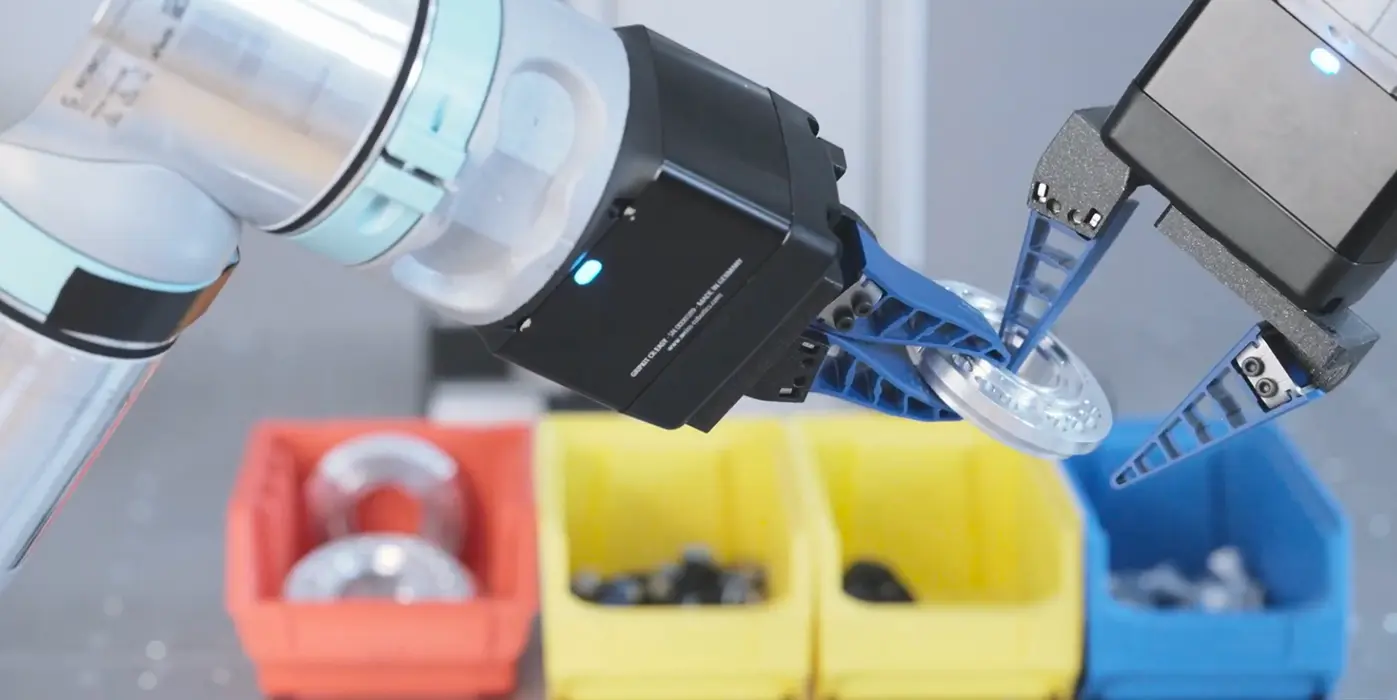
Dual robot arms enable sensitive handling for machine tending, intralogistics, and assembly. Bimanual manipulation lets Alfie handle tasks that need two hands working together, like holding a part steady while the other hand works on it.
Self-Learned Improvements
Physical AI lets Alfie improve on the job and minimize manual intervention. Self-learning policies allow autonomous operation, so the system adapts to new tasks on the fly without rigid pre-programming.
Alfie Takes Over When Traditional Industrial Robots Reach Their Limits
Most industrial robots are designed to repeat one precise motion thousands of times, without deviation. Change the part, the container or the feed position, and someone has to reprogram the cell or build a new fixture. Collaborative robotics (cobots) lower the safety barrier, but they inherit the same limit and still follow fixed paths.
When parts arrive unsorted, in mixed bins or on changing pallets, throughput collapses. That is why so many real processes get filed as "not automatable". The task is not impossible. Rigid systems were simply the only option on the table.
RobCo already automates the structured, repeatable cases with its modular industrial robots. Alfie extends that reach to the unstructured, high-variance work that classic programming cannot cover.
Autonomy
Pushing Autonomous Industrial Robotics to Level 4 Autonomy
A robot is considered autonomous when it can sense, decide and act with minimal human input. As an Autonomous Industrial Robot, Alfie advances robotics toward Level 3 and 4 autonomy, where systems learn, adapt, and execute tasks with little manual intervention. Autonomous robots must handle the unexpected: a shifted part, a new object, a changed layout.
Alfie does this by combining bimanual manipulation with Physical AI. It learns through simulation, teleoperation, or on-site learning, then refines its policies on the job. Alfie handles complex processes involving high variation in parts and tasks. Unlike traditional robotics limited to repetitive applications, Alfie is built for dynamic environments and continuously improves its awareness and execution to manage constant change.
When an autonomous system meets a task it has not seen before, Alfie adapts its grasp and motion instead of stopping for a programmer. This minimal need for human intervention is what separates an autonomous system from a pre-programmed one.
Concept Robot @ RobCo
Alfie as the Autonomous Industrial Robot on the Factory Floor
Alfie is not bolted to one spot. As an Autonomous Industrial Robot, it moves between machines, pallets and staging areas, bringing bimanual manipulation to the point of work. Traditional mobile robots are mainly used to move goods from A to B. Alfie goes further, because it navigates the floor and then performs the task once it arrives.
Designed for a mobile platform, the autonomous robot combines mobile robotics with dexterous handling, so one system both moves and manipulates.
Autonomous navigation lets Alfie work as one of the few autonomous mobile robots that both move and manipulate. Onboard sensors such as cameras, LiDAR and computer vision plan a safe route in real time. This is what allows autonomous robots to keep adapting as the floor changes.
Safety and Integration of the Autonomous Industrial Robot
Safety is the strongest trust signal for autonomous robots, and it is where most claims go quiet. Alfie’s safety concept is being developed around the standards that govern industrial and mobile robots, so it can share the floor with people without a safety fence. For system integration, Alfie is built to fit the operating environment and IT you already run. Where several units work together, robot fleet management coordinates tasks across the floor through cloud-based fleet management software.
Alfie Takes on Any Task
Built for the Real Factory Floor
High part variance, changing layouts, mixed containers: the processes rigid cells were never able to hold. These are the everyday applications of autonomous robots and autonomous systems on a modern factory floor.
Across these tasks, the common thread is variability. Alfie fits processes where parts, containers and volumes keep changing, which is where fixed industrial robots stall.
How Alfie Differs From the Humanoid Robots in Viral Demos
You have probably seen humanoid robots dancing or folding shirts in a lab. Those clips answer a research question, not a production one. Alfie is built for reliable work in a real factory, under real cycle times and real safety rules. It borrows the flexibility people associate with humanoid robots, but it is engineered as a certifiable industrial system, not a demo. The real difference shows when the line runs three shifts and the parts never stop changing.
Pricing an Autonomous Robot: The Robotics-as-a-Service Model
There is no six-figure purchase and no capital risk to approve. Alfie is part of RobCo’s modular robot solutions and can run on a Robotics-as-a-Service model, with zero upfront investment, so you pay only for the outcome. The model fits risk-averse procurement and finance teams, because the return on investment (ROI) is tied to output, not to a large capital outlay.
Frequently Asked Questions

Robotic automation means using robots to carry out physical tasks people would otherwise do by hand, such as loading machines or palletizing. Modern autonomous robotics goes further, with systems that sense, decide and adapt to change instead of repeating one fixed motion.
An autonomous industrial robot senses its environment, makes its own decisions, and completes tasks without step-by-step programming. Unlike a fixed industrial robot, it adapts to changing parts, containers and layouts. Alfie is one example, built for high-variance work on the factory floor.
Yes. Alfie is designed as an autonomous mobile robot. It navigates the factory floor and performs bimanual tasks once it reaches the workstation. Where classic mobile robots are mainly used for transport, Alfie both moves and manipulates, combining mobile robotics with dexterous handling.
There is no single price for an automation robot. Cost depends on the task, the number of part variants, cell complexity, safety requirements and integration effort. A simple pick-and-place cell sits far below a flexible, adaptive system. For Alfie, RobCo scopes pricing against your specific process.
Alfie is not a standard autonomous robot for sale. Instead of an outright purchase, RobCo offers it through a Robotics-as-a-Service model, with zero upfront investment, and you pay for the units you need. This keeps the entry risk low and ties cost to real output.
Alfie handles machine tending, palletizing, materials handling, finishing, bin picking and assembly. It suits high part variance and changing layouts across food and beverage, automotive, wood, defense and logistics, the applications of autonomous robots and autonomous systems that rigid cells cannot hold.
Common factory automation tools include industrial robots, cobots, PLCs, machine vision systems and autonomous mobile robots. Each suits a different job. Alfie adds a further category: an autonomous industrial robot that adapts to high-variance work instead of following fixed programming.
The term usually refers to the four largest industrial robot manufacturers, which built the market for fixed industrial robots. RobCo focuses on a newer category: autonomous industrial robots that adapt to changing parts and layouts rather than repeating a programmed path.
Learn more about Alfie – Contact our experts today
Talk to our team about your process. The first step is a short, no-obligation call. Here is what we cover:
- Your process: part variance, containers, layouts and current bottlenecks.
- Feasibility: how Alfie would approach the task, and its current limits.
- Next steps: whether your case qualifies for the pilot program and the timeline.